
How to Craft a Serene Woodland Garden at the Forest's Edge
- lesannsa

- Jan 24
- 16 min read
Updated: Jan 26
“And into the forest I go, to lose my mind and find my soul.” — John Muir

Why create a woodland garden?
Walk slowly or sit peacefully in a forest. Listen to the birds calling in the canopy, the wind rustling through the leaves. Breathe in the scent of damp earth. Feel the spongy soil under your feet. Notice your stress draining away.
The practice of "Forest Bathing," also known by the Japanese term shinrin-yoku, is the act of immersing yourself in a forest environment using all of your senses. This practice invites you to slow down and fully experience the living world. Forest Bathing benefits your physical and psychological health. Research has found that the practice will reduce stress and cortisol levels, lower blood pressure and heart rate, improve mood and mental clarity, support immune function, and encourage creativity and calm (1,2).
A woodland garden presents numerous advantages for both humans and the natural world. The diverse selection of native trees and shrubs found in such gardens provides crucial habitats for birds, mammals, and insects. Trees deliver a range of ecological benefits, including climate change mitigation, improved air and water quality, and soil stabilization. Introducing even a single keystone species, such as an oak tree, into your garden can result in significant long-term benefits for wildlife.

A woodland garden evolves progressively, layer by layer, in harmony with the natural landscape, necessitating patience. Achieving full maturity of the garden may span 10 to 50 years. Nevertheless, the journey of cultivating the garden is inherently rewarding.
Five years ago, I began to intentionally create a woodland garden by planting trees. Three year ago, I added large shrubs to the same area. Over the past two years, I have progressively introduced perennials and ground covers into the garden. This blog will explore how to develop a woodland garden. I will focus on site assessment, soil enhancement, and the selection of suitable plants—including trees, shrubs, perennials, and spring ephemerals—that support wildlife and offer year-round appeal. Whether you have a large property with mature trees or a small shaded area in your yard, a woodland garden can transform your space into a tranquil retreat right outside your door.

Select a Suitable Site
The key characteristics of a woodland garden are:
dappled shade
moist, rich, acidic soil
layered plantings
wildlife habitats
woodland plants
and naturalistic design elements (e.g. winding informal pathways).
Many woodland plants are shade lovers - so look for areas on your property that receive shade at various times throughout the day. These areas may be within an existing forest, clusters of trees, or at locations near trees, fences, or buildings that provide shade. Woodlands can be categorized into different types, such as groves, open wooded habitats, and glades. Each type is distinguished by the canopy cover: groves have over 70% cover, open habitats have 20-70% cover, and glades have less than 20% cover.
Woodlands can also be differentiated based on their location (e.g. hilltops versus lowlands), soil characteristics (e.g. pH and texture), and hydrology (how water moves through the land). Each type supports a unique ecological community of plants and wildlife - e.g. Garry Oak meadows. It is essential to consider the location and type of woodland you intend to establish and to choose the "right plants for the right place and purpose."

How to Work with an Existing Woodland
To transform an existing grove of trees into a woodland garden, it is important to assess the sunlight penetration reaching the forest floor. In a mature forest, thinning the canopy may be required to improve light availability for understory and groundcover plants. Conduct a comprehensive inspection and inventory of the current vegetation.
Assess whether the ecosystem is healthy or if there are signs of pests, disease, or invasive plants that could impede your plans. If the plant community is thriving, it may be best to leave it undisturbed. Many woodland trees, such as large maples, have superficial roots that could be disrupted by planting shrubs. However, if the woodland contains struggling or invasive plants, along with dead or diseased trees, there may be an opportunity to clear these elements, thereby creating sunlit glades within the woodland suitable for gardening.

Next, assess the soil. The foundation of woodland gardens in the Pacific Northwest is nutrient-rich, organic soil. It is advisable to test the soil's pH, as selecting plants that are well-suited to the existing soil conditions is preferable to attempting to modify the soil's pH. To evaluate the soil quality at your site, take a handful and compress it. Ideally, the soil should retain its shape when squeezed but crumble easily when disturbed. If the soil structure is not ideal, it can be improved by adding significant quantities of organic matter.
For a woodland garden, it is ideal to have soil that is consistently moist yet well-drained, often termed "evenly moist." The soil should neither be waterlogged nor completely dry. However, certain natural woodlands, like wet lowlands, may experience seasonal water logging. If your site tends to accumulate water during the winter, it may be necessary to elevate your planting beds or redirect the water, particularly if you plan to introduce exotic plants into your garden.
Alternatively, you can adapt to the natural conditions of your location and select plants that are well suited to that environment - wet or dry. There are several online woodland resource sites listed in the resource section below that provide lists of suitable plants for specific types of woodlands.
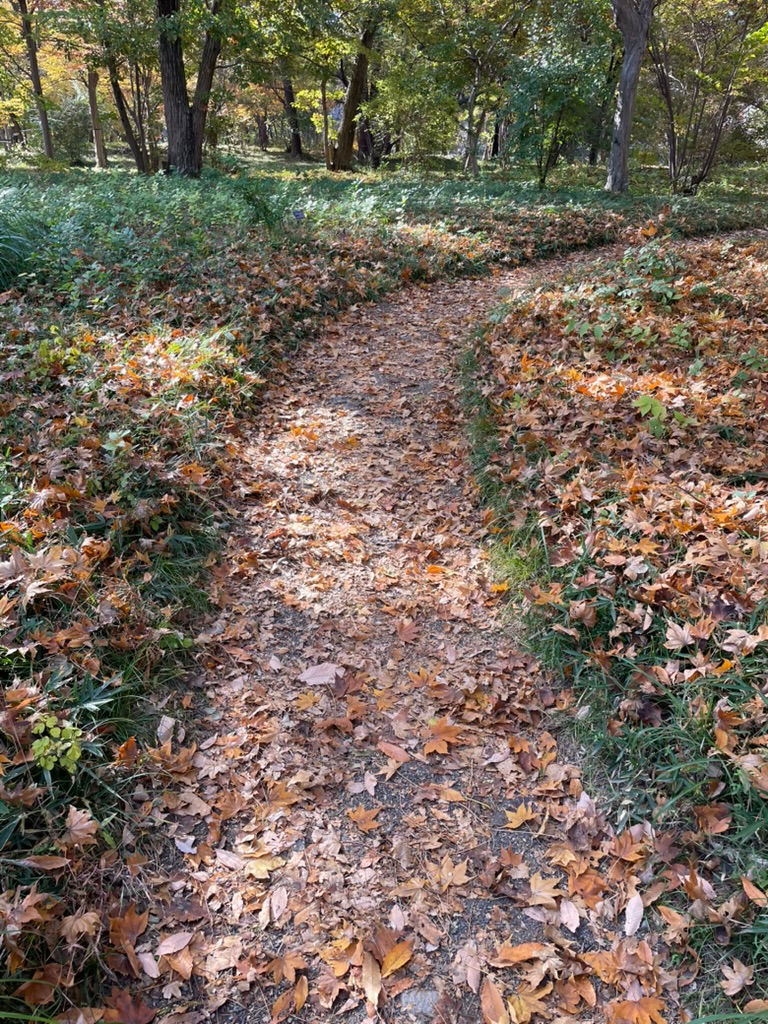
When deciding upon a site, carefully assess how you would navigate through the existing woodland and how it integrates with other areas of your property. Woodland gardens typically feature gently winding paths that lead to a destination, a viewpoint, or loop back through the area. If your land includes attractive natural features such as rock formations, streams, or ponds, consider designing your woodland path to direct visitors to these points of interest.
Start From Scratch
Another approach is to create a woodland garden along the edge of an existing forest. This is a great strategy as it takes advantage of the shade provided by the forest but minimizes disturbing the natural forest. Ideally, in the Northern Hemisphere the garden should be oriented to the north, allowing it to receive sunlight in the early morning and late afternoon. The site may experience different levels of shade throughout the day, ranging from partial shade to dappled or full shade, depending on the season. You will need to take this into consideration when laying out your plants. The benefit of starting anew is the opportunity to design your pathway first and subsequently develop the garden around it.


In an urban environment, if you have a small garden, consider utilizing the shade provided by nearby fences, buildings, or trees. In the Northern Hemisphere, a garden located in the southeast corner of a fenced area will benefit from morning sunlight and afternoon shade. For gardens that receive ample sunlight, shade can be introduced by strategically planting two to three small trees and a selection of large and small shrubs. This approach can create a woodland atmosphere, even in a modest, sheltered garden corner.

Improve Soil & Build the Forest Floor
If you plan on converting a small patch of grass, or a bare field, into a woodland garden you will need to remove the existing vegetation. If you have access to plenty of leaves you can just lay down a very thick layer of leaves. Otherwise, cut the existing grass. Then layer cardboard or thick paper bags over the area to kill the vegetation. Then add a minimum of 30 cm (12 inches) of mulch. You can use fine organic matter (leaf mold, organic compost, well rotted manure) and/or coarse organic matter (leaves, shredded bark, pine needles) on top. Leave for at least 6 months.


Preparing site: Cardboard laid down, bags of leaves collected, area covered with leaves.
In the Pacific Northwest, the forests are temperate rainforests. The ideal soil pH in this region for a woodland garden is slightly acidic - with a pH ranging from 5.5 to 6.5. To improve the soil texture, build up the top layer of soil - avoid deep digging. Add 5-8 cm of organic material initially, and then top up annually as needed. Materials such as leaf mold and pine bark are effective in maintaining soil acidity. The decomposition of organic matter will result in humus-rich soil, which enhances the soil's moisture retention capabilities. Allow fallen leaves, trees and branches to decompose naturally to add to the top layer.
How to Design Your Woodland: Think in Layers
Woodland gardens are built in vertical layers, just like nature. These layers include:
Canopy (tall trees)
Understory (small trees, large and small shrubs)
Woodland floor (perennials, ferns, ground covers)
Vertical/climbing layer
Root layer

Layers Encourage Wildlife
Planting in layers benefits wildlife. Each vegetative layer offers distinct resources such as food, shelter, space, and water to various insects, birds, mammals, fungi, and microbes. The layered approach enhances both the complexity of the landscape and the biodiversity of the woodland.
How to Build Layers - Start Big, Go Small
Patience is key. If you are starting from scratch (a bare area of soil), a woodland garden takes years to mature. So if you are thinking about it, now is the time to get started. The key to creating a woodland garden is to start big and go small.
Year One
Start by choosing tall trees that will create the canopy of your woodland garden.
Woodland gardens can feature both deciduous and evergreen trees. Deciduous trees shed their leaves in winter, which increases sunlight in spring—essential for spring ephemerals. The fallen leaves enrich the woodland floor. By the time these trees develop their foliage, the spring ephemerals will have completed their growth cycle and will enter dormancy.

Evergreen trees offer structure, year-round shade, and winter shelter - particularly if positioned to shield against prevailing winter winds. Many conifers, such as Douglas-fir (Pseudotsuga menziesii), Ponderosa pine (Pinus ponderosa) and Eastern White Pine (Pinus strobus), are deep-rooted and can tolerate plants growing beneath them. Numerous pine species also have attractive forms, beautiful bark, and can be pruned to allow light to reach the forest floor.
Other factors to consider when selecting trees include:
Hardiness: Choose trees that are hardy in your region. These trees provide structure and shade, and losing one due to a sudden cold weather event could be detrimental.
Foliage: Opt for a tree that allows sunlight to filter through its foliage, such as those with smaller leaves (e.g. smaller leaf maples over large leaf maples).

Size and Root Structure: Keep in mind that large canopies correspond to wide root zones. If working along the edge of an existing forest, select medium (6-15m) to small (4.5-9m) trees. In confined spaces or near structures, it is advisable to choose trees with deep, penetrating roots (e.g. oaks) rather than those with large, superficial spreading roots (e.g. beeches).
Year-Round Features: Consider attributes such as tree form, flowers/berries, fall colour, and attractive bark that provide interest throughout the year.
Growth rate: If your site lacks significant shade, consider choosing fast-growing trees like red alders (Alnus rubra). This tree is one of the quickest native trees to create shade. It is also a nitrogen-fixer and enriches the soil. It will act as a nurse tree, sheltering slower, long-lived species like Garry oak.
Drought Tolerance: Most newly planted trees will require additional water to establish. The larger the new tree's girth, the more water it will need. Generally, new trees need 8 litres of water for every 2.5 cm of trunk diameter per week. Therefore, if you reside in a dry area with minimal summer rainfall, choose smaller specimen trees, and drought-tolerant trees to reduce the need for supplemental watering.
Wildlife Support: To enhance the biodiversity of your woodland, it is best to select native trees for your canopy trees. These trees can provide nesting sites, food sources such as flowers, pollen, seeds, and cones, and act as host plants for insects and caterpillars. Oak foliage, in particular, supports a wide variety of caterpillars, which are vital food sources for breeding birds and other wildlife.

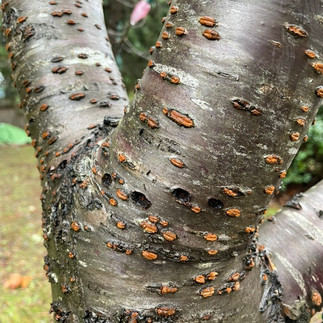

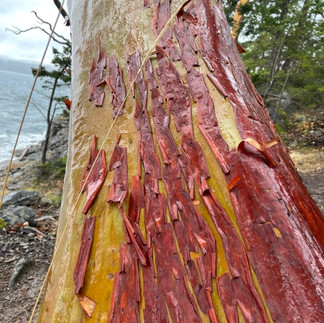



Above: Fall planting of canopy trees in our woodland. Trees were planted in the field and then mulched, caged and watered weekly until the fall rains arrived.
Years Two and Three
Work from the top down - small trees, big shrubs and small shrubs. After planting your canopy trees, plant small understory trees and shrubs that are suitable for the light conditions of your site. The understory play a big role in setting the aesthetic of your woodland, so it's worth putting some thought into the design. Repeat the small trees throughout the area to create unity throughout the woodland. Then, mix it up with a variety of deciduous and evergreen shrubs that have different leaf textures for some strong visual contrast. Pick shrubs that bloom at different times (spring, summer and winter), you’ll not only create year round interest but also give pollinators a hand.
Plant large, fast-growing shrubs that will tolerate sun and partial shade. These large shrubs will create ground-level shade quickly. You can then plant your small shrubs and woodland perennials around the base of these shrubs. Pussy willows (e.g. Salix discolor) are excellent fast-growing shrubs that provide early shade and can be cut right back down to the ground when they get too big.
Plant some small shrubs like Mahonia nervosa or Sarcococca hookeriana 'var. humilis' at the base of bigger shrubs to tie everything together nicely. Finally, as the shade on your site increases, you can plant shrubs that prefer partial to full shade. These shrubs often have large broad evergreen leaves (e.g. species rhododendrons) that add interesting texture to your garden.


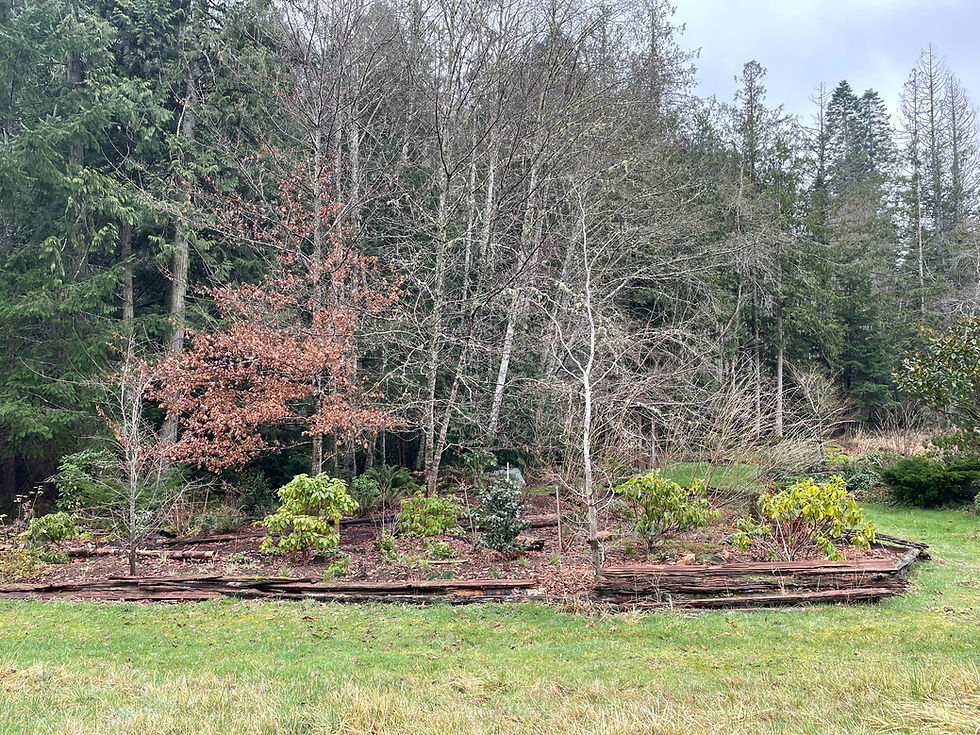
Above: Our woodland project - rhododendrons planted in field. Entire area mulched. Perennials and ground covers planted under trees and around shrubs.
Year Three and Beyond - Focus on the Woodland Floor
Be aware, as your woodland canopy matures, light conditions will change. Your garden will evolve, with some plants thriving and others potentially disappearing. If you've already got a shrub layer established, you can jump right into underplanting with perennials. As those shrubs grow, you can expand your planting areas.
In sunnier exposed spots, try using geraniums as ground covers since they do well in both sun and partial shade. Once there's enough shade, you can add ground cover plants that prefer full shade. You might want to add more mulch now and then, to keep weeds at bay while waiting for the trees and shrubs to settle in. Plant spring ephemerals, such as trillium and dogtooth violet, in pockets of rich soil or compost beneath shrubs and trees, and leave them undisturbed. Mark them well, so you do not dig them up accidentally. With any luck, they will naturalize to create carpets of wildflowers.
Choosing Woodland-Friendly Plants
An essential element in the design of a woodland garden is the careful selection of plant species. Early plant explorers gathered remarkable woodland plants from Eastern North America, Europe and Asia. Species such as rhododendrons, azaleas, and Japanese maples were widely utilized at the turn of the century to craft exotic woodland gardens. If you have visited some of the renowned woodland gardens in British Columbia, you may find yourself inspired to create your own woodland garden with similar exotic plants.

However, with the decline of natural landscapes, it is imperative to take the opportunity to restore natural habitats. Local wildlife has co-evolved with native plants and depends on them for survival. Therefore, incorporating native plants, especially keystone species, into a new woodland garden is crucial for supporting local wildlife. To optimize ecological health in a woodland, it is generally recommended to maintain a composition of at least 70% native species, with no more than 30% non-invasive, non-native species. This balance ensures the ecosystem effectively supports local wildlife, especially insects and birds, while also providing aesthetic variety.
In particular, it is important to avoid introducing non-native plants that are aggressive spreaders which may encroach upon wild landscapes, such as
False lily of the valley (Maianthemum)
Carpet bugle (Ajuga)
Loosestrife (Lysimachia)
Common bluebell (Hyacinthoides non-scripta)
Common periwinkle (Vinca minor)
Common Ivy (Hedera helix)
Always consider native plant alternatives, for example use trilliums and/or camass bulbs instead of English bluebells. Whenever possible, choose locally sourced and responsibly cultivated native plants. Never remove native plants from the wild. Purchasing plants from local nurseries that propagate them ensures you receive flora that is genetically suited to your environment.
Below are some of my favourite plants that are suitable for a PNW woodland garden.
Layer | Native Plants | Exotic Plants |
Canopy - tall trees |
|
|
Understory - small trees and large shrubs |
|
|
Deciduous Shrubs |
|
|
Evergreen Shrubs |
|
|
Perennials |
|
|
Ferns |
|
|
Ground Covers |
|
|
Spring Ephemerals |
|
|
Vines |
| Sweet Autumn Clematis (Clematis terniflora) Seagull Rose (R. Seagull) |

How to Lay Out Your Woodland Garden
Here are two examples of planting plans for the Pacific Northwest. The first plan is for a large area of 20 x 6 m at the edge of a forest, and the second is a plan for smaller garden area measuring 3 m x 3 m. Both use use native plants from the Pacific Northwest climate, but non-native plants could be thoughtfully substituted.
Plan One Forest Edge

Canopy Layer (C) – 7.5–9 m spacing
C1, C3: Garry oak (Quercus garryana)
C2: Arbutus / Pacific madrone (Arbutus menziesii)
Understory Trees (U) – 3–4.5 m spacing
U1, U3: Vine maple (Acer circinatum)
U2: Pacific serviceberry (Amelanchier alnifolia)
Shrub Layer (S) – 1.2–1.8 m spacing, planted in drifts
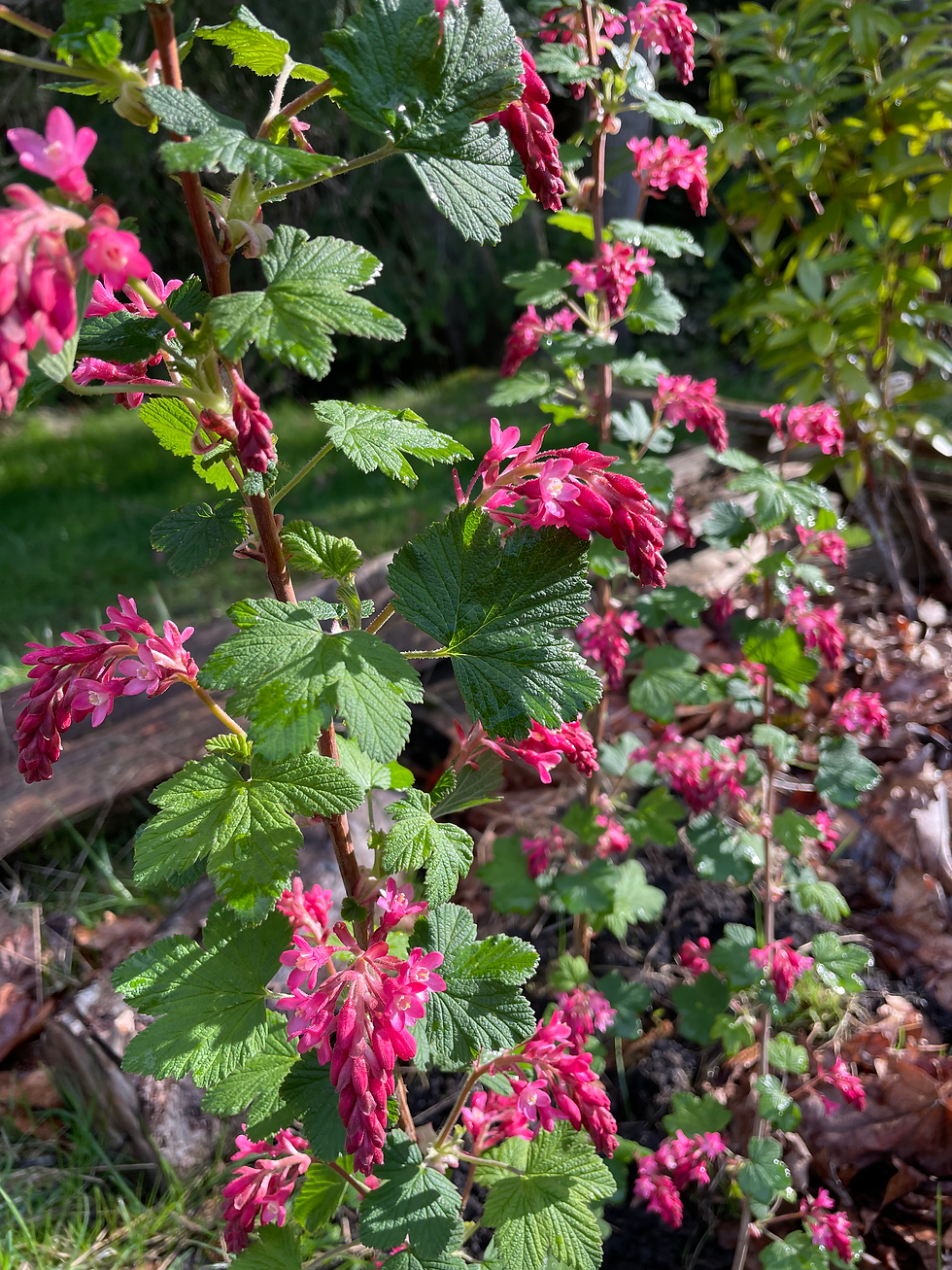
S1–S3: Red-flowering currant (Ribes sanguineum)
S4–S6: Evergreen huckleberry (Vaccinium ovatum)
S7–S9: Salal (Gaultheria shallon)
S10–S12: Snowberry (Symphoricarpos albus)
Herbaceous Layer (H) – 30–60 cm spacing
H1–H3: Western columbine (Aquilegia formosa)
H4–H6: Woodland phlox (Phlox adsurgens)
H7–H9: Foamflower (Tiarella cordifolia)
H10–H14: Sword fern (Polystichum munitum)
Groundcover (G) – 20–30 cm spacing
G1–G5: Inside-out flower (Vancouveria hexandra)
G6–G10: Wild ginger (Asarum caudatum)
G11–G15: Kinnikinnick (Arctostaphylos uva-ursi)
Vertical / Climbing Layer (interwoven)
Orange honeysuckle (Lonicera ciliosa) trained through shrubs near S3, S8, S11
Coastal clematis (Clematis ligusticifolia) along canopy trunks C1 & C3
Plan Two Small Woodland Garden
This plan could be used for a small woodland in an urban garden. In an area of 3 x 3 meters you could plant
3 small trees (5–10 gal)
Vine maple (V)
Pacific dogwood (D)
Japanese maple (JM)
2 deciduous shrubs (2-3 gal)
Indian plum (IP)
Red-flowering currant (RC)
2 small evergreen shrubs Dull Oregon-grape (O)
1 structural fern (1-2 gal) e.g. Sword Fern (Polystichum munitum)
10–15 woodland perennials to form a ground cover (gc) such as Foamflower, Inside-Out flower, and/or False Solomon's Seal (9 cm / 1 qt).
12–20 bulbs (b) (e.g. winter aconite, snowdrops, daffodils) planted in drifts.
You could lay out the plants as sketched below. Space the small trees 1.5m-2m apart, the shrubs 0.8m-1m apart, and the woodland perennials/ground covers at 30cm-45 cm intervals. Fill in the empty spaces with drifts of naturalizing bulbs.
Scale: 1 cell = 0.5 m × 0.5 m (Back = North, Front = South)
V gc | gc | D | |||
bbbbb | IP gc | gc | gc | RC | gc |
gc | gc | SF | gc | gc | |
gc | bbbbb | JM | gc | ||
O gc | gc | gc | bbbbb | O | gc |
gc | gc | gc | gc | bbbbb |

Conclusion
When you plant with purpose and give it time to grow, a woodland garden turns into more than just a garden—it's a lasting legacy. By working with the natural layers of a forest—like the canopy, understory, shrubs, and ground—you build a strong system that boosts biodiversity, improves soil health, balances the climate, and gracefully changes over time. Whether you fill it with native plants or mix in some well-behaved non-natives, a woodland garden is all about patience. In the end, creating a woodland garden is about taking care of the land. It reconnects our cultivated spaces with the natural world's rhythms, offering beauty, a home, and a refuge—for both people and nature.
References:
(1) Li Q. Effects of forest environment (Shinrin-yoku/Forest bathing) on health promotion and disease prevention -the Establishment of "Forest Medicine". Environ Health Prev Med. 2022;27:43. doi: 10.1265/ehpm.22-00160. PMID: 36328581; PMCID: PMC9665958.
(2) Antonelli M, Donelli D, Carlone L, Maggini V, Firenzuoli F, Bedeschi E. Effects of forest bathing (shinrin-yoku) on individual well-being: an umbrella review. Int J Environ Health Res. 2022 Aug;32(8):1842-1867. doi: 10.1080/09603123.2021.1919293. Epub 2021 Apr 28. PMID: 33910423.
Resources:
Forster R. R., Downie A. M., . (2004). The woodland garden. Buffalo, N.Y: Firefly Books.
Cox, K. (2018). Woodland gardening: landscaping with rhododendrons, magnolias & camellias and acid-loving plant. Perth, Scotland: Glendoick Publishing.
ISBN 10: 1527217876 / ISBN 13: 9781527217874
Sjöman H., Anderson A., . (2023). The essential tree selection guide. Bath: Filbert Press.
University of British Columbia. Vancouver Trees [Mobile application software]. Author: Douglas Justice "Vancouver Trees will definitely help users to make informed decisions when planting and designing with trees."
Garry Oak Woodland Resource: Garry Oak ecosystems recovery team website The website and handbook provide excellent advice for designing, and planting a Garry Oak woodland and or meadow.
Woodland Creation Guide This UK guide sets out the Woodland Trust's approach to woodland creation. It describes in detail the phases of the process and the principles they apply. It includes detailed plant lists for specific ecosystems. Free to download.
Related posts: Learn to Love ... the Beauty of Hellebores and ...Spring Ephemerals


Comments